

EUR to USD - Convert Euro to US Dollar
2025 Average Rate: 1 EUR = 1.09 USD
The EUR to USD exchange rate is one of the most important currency pairs in global financial markets, connecting the Eurozone (representing 19 European countries) with the world's largest economy. Throughout 2025, 1 Euro averaged approximately 1.09 US Dollars at mid-market rates. This conversion is essential for travelers, businesses, investors, and anyone dealing with transactions between Europe and the United States.
The relationship between the Euro and US Dollar reflects complex economic factors including monetary policy differences between the European Central Bank and Federal Reserve, trade relationships, political developments, and global market sentiment. Understanding how to convert EUR to USD accurately and staying informed about exchange rate movements can help you make better financial decisions.
Average EUR to USD Exchange Rate in 2025
2025 Annual Average:
- 1 EUR = 1.09 USD (average mid-market rate for 2025)
- Range: The rate fluctuated between approximately 1.04 and 1.14 USD throughout the year
- Rate type: Mid-market rate (average between buy and sell prices)
💡 For Real-Time Exchange Rates
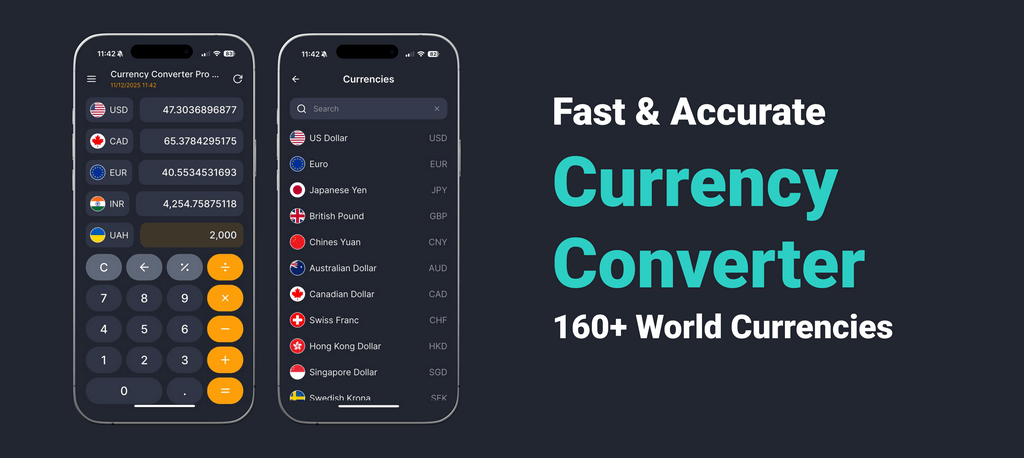
Exchange rates change throughout each trading day. For the most up-to-date EUR to USD rates updated in real-time, download our Currency Converter Pro Live app:
- Download on the App Store - Get live rates on iPhone and iPad
- Get it on Google Play - Get live rates on Android devices
The app provides real-time exchange rates for 160+ world currencies, updated throughout each trading day based on live market data.
The mid-market rate represents the midpoint between what buyers are willing to pay and what sellers are asking for in global currency markets. When you exchange currency through banks or money transfer services, you'll typically receive a rate that includes a margin of 2-5% above or below this mid-market rate.
Quick Conversion Examples (Based on 2025 Average Rate)
- €1 EUR = $1.09 USD
- €10 EUR = $10.90 USD
- €100 EUR = $109.00 USD
- €1,000 EUR = $1,090.00 USD
- €10,000 EUR = $10,900.00 USD
These conversions use the 2025 average mid-market rate and are for informational purposes only. Actual rates you receive may vary based on the service provider, transfer amount, and payment method. For real-time rates, use the Currency Converter Pro Live app available in the header above.
How to Convert EUR to USD
Converting Euros to US Dollars is straightforward once you understand the process:
Step 1: Determine the Exchange Rate
Check the EUR to USD rate from reliable sources such as the European Central Bank (ECB), US Federal Reserve, major financial institutions, or currency converter apps. The average rate in 2025 was approximately 1.09 USD per EUR (or 0.92 EUR per USD), but rates fluctuate throughout each trading day based on market conditions. For real-time rates, consider using a currency converter app like Currency Converter Pro Live available in the header above.
Step 2: Calculate the Conversion
Multiply the amount in EUR by the exchange rate. For example, using the 2025 average rate:
- If 1 EUR = 1.09 USD (2025 average)
- Then 1,000 EUR = 1,000 × 1.09 = $1,090.00 USD
Alternatively, you can divide the amount in EUR by the USD to EUR rate:
- If 1 USD = 0.92 EUR (2025 average)
- Then 1,000 EUR ÷ 0.92 = $1,086.96 USD
Note: For real-time calculations with current rates, use the Currency Converter Pro Live app available in the header above.
Step 3: Choose Your Conversion Method
You can convert INR to USD through:
- Banks: Traditional banks offer currency exchange services, typically with higher fees
- Money transfer services: Online services like Wise, Remitly, or Xoom often provide better rates
- Currency exchange offices: Physical locations at airports or tourist areas, usually with less favorable rates
- Mobile apps: Currency converter apps provide real-time rates and some offer conversion services
Step 4: Consider Fees and Margins
Remember that the rate you see (mid-market rate) is not the rate you'll receive. Service providers add margins and fees:
- Banks: Typically 3-5% margin
- Money transfer services: 1-3% margin
- Exchange offices: 5-10% margin or more
Always check the total cost, including fees, before completing a transaction.
Factors Affecting EUR to USD Exchange Rate
The EUR to USD exchange rate is influenced by various economic and political factors:
Monetary Policy
The European Central Bank (ECB) and Federal Reserve (Fed) set interest rates that directly impact currency values. When the ECB raises rates, the EUR typically strengthens against USD. When the Fed raises rates, the USD typically strengthens. Interest rate differentials are a key driver of EUR to USD exchange rate movements.
Economic Indicators
Key economic data affects the exchange rate:
- GDP growth rates in the Eurozone and US
- Inflation rates (CPI)
- Employment data
- Trade balances
- Foreign direct investment flows
Political Events
Major political developments can cause significant rate movements:
- Elections and policy changes in Europe and the US
- Trade disputes
- Geopolitical tensions
- Brexit and its ongoing effects on European markets
- EU integration or fragmentation concerns
Market Sentiment
Investor confidence and risk appetite influence currency flows:
- Safe-haven demand for USD during uncertainty weakens EUR
- Risk-on sentiment favoring EUR during stability
- Global market volatility affects both currencies
Eurozone Stability
The EUR's value is influenced by the economic health of all 19 Eurozone countries:
- Debt crises in individual countries can weaken the EUR
- Strong economic performance across the Eurozone strengthens the EUR
- Political unity or fragmentation concerns affect investor confidence
Historical EUR to USD Exchange Rate
The EUR to USD exchange rate has experienced significant fluctuations since the Euro's introduction in 1999:
Recent History (2020-2026)
- 2020: The rate averaged around 1.10-1.14 USD per EUR (0.88-0.91 EUR per USD), with volatility during the COVID-19 pandemic
- 2021: Continued strength in EUR, with rates reaching 1.18-1.20 USD per EUR (0.83-0.85 EUR per USD)
- 2022: The rate declined to 1.05-1.10 USD per EUR (0.91-0.95 EUR per USD), driven by US Federal Reserve interest rate hikes and global economic uncertainty
- 2023: Further USD appreciation, with rates reaching 1.04-1.08 USD per EUR (0.93-0.96 EUR per USD)
- 2024: The rate continued to decline, reaching 1.00-1.05 USD per EUR range (0.95-1.00 EUR per USD)
- 2025: Current levels around 1.04-1.14 USD per EUR (0.88-0.96 EUR per USD), reflecting relative economic stability between the two regions
Long-term Trends
- 1999-2002: The Euro started weak against the USD, reaching lows around 0.82-0.85 EUR per USD (1.18-1.22 USD per EUR) in 2000-2001
- 2002-2008: The Euro strengthened significantly, reaching highs above 1.60 USD per EUR (0.625 EUR per USD) in 2008
- 2008-2012: The 2008 financial crisis initially strengthened the USD, pushing the rate down to around 1.25-1.30 USD per EUR (0.77-0.80 EUR per USD)
- 2015-2025: The rate has generally ranged between 1.04 and 1.20 USD per EUR (0.83-0.96 EUR per USD)
The long-term fluctuations reflect various factors including monetary policy differences, economic growth patterns, and structural changes in both economies.
Euro Banknote Design
The Euro features distinctive banknote designs that reflect European unity:
Current Series (Europa Series)
Euro banknotes come in denominations of €5, €10, €20, €50, €100, €200, and €500. Each note features:
- Architectural styles from different periods in European history
- Windows and gateways on the front, symbolizing openness and cooperation
- Bridges on the reverse, representing connections between people
- Security features including watermarks, security threads, holograms, and color-shifting ink
- Europa figure (from Greek mythology) on newer notes as an additional security feature
Currency Symbol
The Euro symbol (€) was designed by a team of European experts and represents the letter "E" for Europe, with two parallel lines symbolizing stability.
Interesting Facts About EUR to USD Conversion
- Most Traded Pair: The EUR/USD pair is the most traded currency pair in the world, accounting for approximately 24% of all foreign exchange transactions daily. This high liquidity means tight spreads and efficient price discovery.
- Eurozone Coverage: The Euro is the official currency of 19 European Union member states, collectively known as the Eurozone: Austria, Belgium, Cyprus, Estonia, Finland, France, Germany, Greece, Ireland, Italy, Latvia, Lithuania, Luxembourg, Malta, Netherlands, Portugal, Slovakia, Slovenia, and Spain.
- Central Bank Coordination: While the ECB and Fed operate independently, they sometimes coordinate policies during global crises. This coordination can influence the EUR/USD exchange rate.
- Time Zone Advantage: The EUR/USD pair benefits from overlapping trading hours between New York and European markets, creating high liquidity during these periods (typically 8:00 AM to 12:00 PM EST).
- Historical Context: When the Euro was introduced in 1999, it started at approximately 1.17 USD per EUR. The currency has experienced significant fluctuations, reaching highs above 1.60 USD per EUR in 2008 and lows around 0.82 EUR per USD (1.22 USD per EUR) in 2000.
- Brexit Impact: The UK's departure from the EU (Brexit) has had ongoing effects on European markets and the EUR, though the UK never used the Euro. The uncertainty and economic adjustments have influenced EUR to USD rates.
- Dual Reserve Currency: Both EUR and USD serve as major reserve currencies globally. Central banks hold significant amounts of both currencies, creating steady demand and influencing exchange rates.
Common Use Cases for EUR to USD Conversion
Travel and Tourism
Travelers visiting the United States from Europe need to convert EUR to USD for local expenses. Understanding the current rate helps budget effectively for hotels, meals, transportation, and shopping. The rate directly impacts travel costs.
Business and Trade
Companies importing goods from the United States or exporting to the US need accurate EUR to USD conversion for pricing, invoicing, and financial planning. Exchange rate fluctuations directly impact profit margins and competitiveness.
Investment
Investors looking to invest in US markets from Europe need to convert EUR to USD. Currency movements can enhance or reduce investment returns. A stronger USD means European investors need more euros to buy the same amount of US assets.
Education
Students studying in the US from Europe need currency conversion for tuition fees, living expenses, and other costs. The EUR to USD rate significantly impacts the total cost of US education for European students.
Online Shopping and Services
E-commerce transactions and subscription services from US companies require EUR to USD conversion. Understanding exchange rates helps consumers make informed purchasing decisions and avoid unfavorable conversion fees.
Real Estate
European investors purchasing US real estate need to convert EUR to USD. Exchange rate movements can significantly affect the total cost of property purchases.
Import Payments
European businesses importing goods, services, or technology from the US need to convert EUR to USD for payments. Exchange rate movements directly affect import costs and pricing.
Frequently Asked Questions (FAQ)
Data Source and Trust
How we calculate exchange rates
Our exchange rate data is aggregated from multiple international sources including:
- Interbank foreign exchange markets
- European Central Bank (ECB) reference rates
- US Federal Reserve data
- International Monetary Fund (IMF) statistics
- Major financial institutions and currency data providers
Rates are updated in real-time during market hours and reflect mid-market rates (the average between buy and sell prices). Actual rates you receive from banks or exchange services may include margins of 2-10% depending on the provider.
For official exchange rates and monetary policy information, visit the European Central Bank or the US Federal Reserve.
Last updated: January 17, 2026