

Major Currencies - World's Most Traded Currency Pairs
Major currencies are the world's most traded and liquid currencies, representing the largest economies and most stable financial systems. These currencies form the backbone of global foreign exchange markets, accounting for the majority of daily trading volume. Understanding major currency pairs is essential for anyone involved in international trade, travel, investment, or currency conversion.
The major currencies include the Euro (EUR), British Pound (GBP), Japanese Yen (JPY), Chinese Yuan (CNY), Indian Rupee (INR), Philippine Peso (PHP), Canadian Dollar (CAD), and Australian Dollar (AUD). These currencies are characterized by high liquidity, stable exchange rates, and significant trading volumes, making them the most reliable and accessible currencies for conversion.
What Are Major Currencies?
Major currencies, also known as "major pairs" in forex trading, are currencies from the world's largest and most developed economies. They share several key characteristics:
- High Liquidity: Major currencies can be easily bought and sold without significantly affecting their exchange rates
- Stable Economies: They represent countries with stable political and economic systems
- Large Trading Volumes: They account for the majority of daily forex trading volume
- Low Spreads: Transaction costs are typically lower due to high liquidity
- Global Acceptance: They are widely accepted and used in international trade
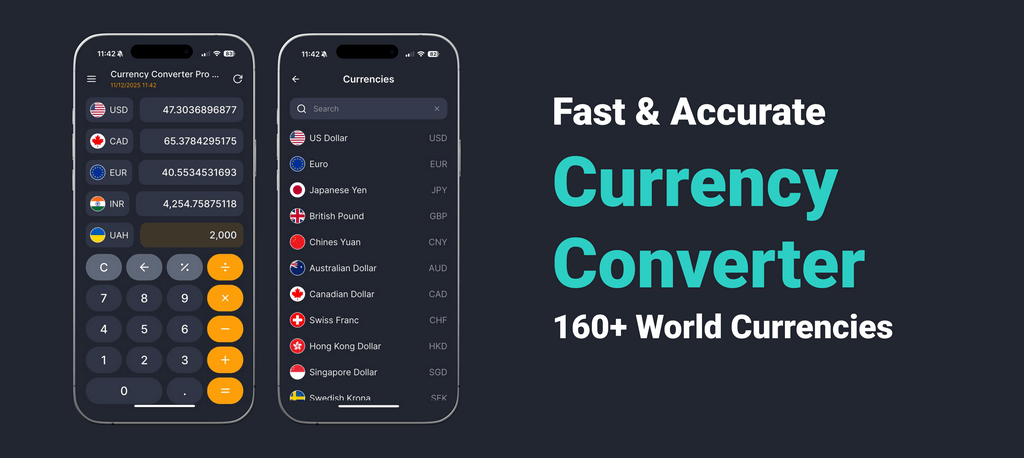
> 💡 For Real-Time Major Currency Exchange Rates: Exchange rates change throughout each trading day. For the most up-to-date major currency rates updated in real-time, download our Currency Converter Pro Live app: > - Download on the App Store - Get live rates on iPhone and iPad > - Get it on Google Play - Get live rates on Android devices > > The app provides real-time exchange rates for 160+ world currencies, updated throughout each trading day based on live market data.
Why Major Currencies Matter
Major currencies form the backbone of global foreign exchange markets, accounting for over 80% of daily trading volume. These currencies represent the world's largest and most stable economies, making them the most liquid and reliable for currency conversion.
The stability and liquidity of major currencies mean:
- Tighter Spreads: Lower transaction costs due to high trading volumes
- Better Rates: More competitive pricing from providers
- Faster Execution: High liquidity ensures quick conversions
- Global Acceptance: Widely accepted in international trade and travel
Understanding major currency pairs helps you make informed decisions about international transactions, whether you're traveling, trading, or managing business finances.
Characteristics of Major Currency Pairs
Major currency pairs share several key characteristics:
- High Liquidity: Can be bought and sold in large volumes without significantly affecting prices
- Stable Economies: Represent countries with strong economic fundamentals and political stability
- Central Bank Credibility: Managed by respected central banks with clear monetary policies
- Low Volatility: Generally less volatile than emerging market currencies
- Transparent Markets: Well-regulated markets with real-time price discovery
These characteristics make major currencies ideal for:
- International trade and commerce
- Travel and tourism
- Investment portfolio diversification
- Remittances and money transfers
- Hedging currency risk
Trading and Conversion Strategies
When converting major currencies, consider:
- Session Timing: Major currencies are most liquid during their home market hours (EUR during European session, JPY during Asian session)
- Economic Calendar: Central bank meetings and economic data releases cause volatility—plan conversions around these events
- Cross-Rate Opportunities: Sometimes converting through a third currency (e.g., USD→EUR→GBP) can be more cost-effective than direct conversion
- Long-Term Trends: Major currencies often follow long-term trends based on interest rate differentials and economic growth
The detailed currency pair pages in this section provide specific information about each major currency, including historical rates, volatility patterns, and conversion tips.
Major Currencies Overview
Euro (EUR)
The Euro is the official currency of 19 European Union member states, collectively known as the Eurozone. It is the second most traded currency globally and serves as a major reserve currency alongside the US Dollar.
- Symbol: €
- ISO Code: EUR
- Central Bank: European Central Bank (ECB)
- Key Features: Used by over 340 million people, stable monetary policy, major reserve currency
British Pound (GBP)
The British Pound Sterling is the oldest currency still in use and the official currency of the United Kingdom. It is one of the most traded currencies globally and maintains significant influence in international finance.
- Symbol: £
- ISO Code: GBP
- Central Bank: Bank of England
- Key Features: Historical significance, major financial center (London), stable economy
Japanese Yen (JPY)
The Japanese Yen is the official currency of Japan, the world's third-largest economy. It is the most traded Asian currency and is known for its stability and low inflation.
- Symbol: ¥
- ISO Code: JPY
- Central Bank: Bank of Japan
- Key Features: Low interest rates, safe-haven currency, major export economy
Chinese Yuan (CNY)
The Chinese Yuan, also known as the Renminbi, is the official currency of China, the world's second-largest economy. Its importance in global trade has grown significantly in recent decades.
- Symbol: ¥ or 元
- ISO Code: CNY
- Central Bank: People's Bank of China
- Key Features: Growing global influence, major trading partner, managed exchange rate
Indian Rupee (INR)
The Indian Rupee is the official currency of India, one of the world's fastest-growing major economies. It is one of the most searched currency pairs globally due to India's large population and growing economy.
- Symbol: ₹
- ISO Code: INR
- Central Bank: Reserve Bank of India
- Key Features: Large economy, growing middle class, high remittance volume
Philippine Peso (PHP)
The Philippine Peso is the official currency of the Philippines, a major emerging market economy in Southeast Asia. It is heavily influenced by remittances from overseas Filipino workers.
- Symbol: ₱
- ISO Code: PHP
- Central Bank: Bangko Sentral ng Pilipinas
- Key Features: High remittance dependency, growing economy, large population
Canadian Dollar (CAD)
The Canadian Dollar, also known as the "Loonie," is the official currency of Canada. It is a commodity currency, closely tied to oil and natural resource prices.
- Symbol: $
- ISO Code: CAD
- Central Bank: Bank of Canada
- Key Features: Commodity-linked, stable economy, major trading partner with US
Australian Dollar (AUD)
The Australian Dollar is the official currency of Australia and is also a commodity currency, heavily influenced by commodity prices, especially iron ore and coal.
- Symbol: $
- ISO Code: AUD
- Central Bank: Reserve Bank of Australia
- Key Features: Commodity-linked, high interest rates historically, stable economy
Major Currency Pairs with USD
USD to Major Currencies
#### USD to EUR (US Dollar to Euro)
- URL: /usd-to-eur
- Average Rate (2025): 1 USD = 0.92 EUR
- Volume: Most traded currency pair globally
- Characteristics: High liquidity, tight spreads, major reserve currencies
- Use Cases: European travel, trade, investment
#### USD to GBP (US Dollar to British Pound)
- URL: /usd-to-gbp
- Average Rate (2025): 1 USD = 0.79 GBP
- Volume: Major currency pair with high liquidity
- Characteristics: Historical significance, major financial center
- Use Cases: UK travel, trade, investment
#### USD to JPY (US Dollar to Japanese Yen)
- URL: /usd-to-jpy
- Average Rate (2025): 1 USD = 150 JPY
- Volume: Most traded Asian currency pair
- Characteristics: Low volatility, safe-haven currency
- Use Cases: Japanese travel, trade, investment
#### USD to CNY (US Dollar to Chinese Yuan)
- URL: /usd-to-cny
- Average Rate (2025): 1 USD = 7.25 CNY
- Volume: Growing importance in global trade
- Characteristics: Managed exchange rate, growing influence
- Use Cases: Chinese trade, investment
#### USD to INR (US Dollar to Indian Rupee)
- URL: /usd-to-inr
- Average Rate (2025): 1 USD = 83 INR
- Volume: One of the most searched currency pairs
- Characteristics: Large economy, growing middle class
- Use Cases: Indian remittances, trade, investment
#### USD to PHP (US Dollar to Philippine Peso)
- URL: /usd-to-php
- Average Rate (2025): 1 USD = 56 PHP
- Volume: High remittance volume
- Characteristics: Remittance-driven, growing economy
- Use Cases: Philippine remittances, trade
#### USD to CAD (US Dollar to Canadian Dollar)
- URL: /usd-to-cad
- Average Rate (2025): 1 USD = 1.35 CAD
- Volume: Major North American pair
- Characteristics: Commodity-linked, stable economy
- Use Cases: Cross-border trade, travel
#### USD to AUD (US Dollar to Australian Dollar)
- URL: /usd-to-aud
- Average Rate (2025): 1 USD = 1.52 AUD
- Volume: Commodity currency pair
- Characteristics: Commodity-linked, high interest rates
- Use Cases: Australian travel, trade, investment
Major Currencies to USD
#### EUR to USD (Euro to US Dollar)
- URL: /eur-to-usd
- Average Rate (2025): 1 EUR = 1.09 USD
- Volume: Most traded currency pair globally
- Characteristics: High liquidity, major reserve currencies
- Use Cases: European exports, investment
#### GBP to USD (British Pound to US Dollar)
- URL: /gbp-to-usd
- Average Rate (2025): 1 GBP = 1.27 USD
- Volume: Major currency pair
- Characteristics: Historical significance, major financial center
- Use Cases: UK exports, investment
#### JPY to USD (Japanese Yen to US Dollar)
- URL: /jpy-to-usd
- Average Rate (2025): 1 JPY = 0.0067 USD
- Volume: Most traded Asian pair
- Characteristics: Low volatility, safe-haven currency
- Use Cases: Japanese exports, investment
#### CNY to USD (Chinese Yuan to US Dollar)
- URL: /cny-to-usd
- Average Rate (2025): 1 CNY = 0.14 USD
- Volume: Growing importance
- Characteristics: Managed exchange rate, growing influence
- Use Cases: Chinese exports, trade
#### INR to USD (Indian Rupee to US Dollar)
- URL: /inr-to-usd
- Average Rate (2025): 1 INR = 0.012 USD
- Volume: One of the most searched pairs
- Characteristics: Large economy, growing middle class
- Use Cases: Indian exports, investment
#### PHP to USD (Philippine Peso to US Dollar)
- URL: /php-to-usd
- Average Rate (2025): 1 PHP = 0.018 USD
- Volume: High remittance volume
- Characteristics: Remittance-driven, growing economy
- Use Cases: Philippine exports, remittances
#### CAD to USD (Canadian Dollar to US Dollar)
- URL: /cad-to-usd
- Average Rate (2025): 1 CAD = 0.74 USD
- Volume: Major North American pair
- Characteristics: Commodity-linked, stable economy
- Use Cases: Canadian exports, trade
#### AUD to USD (Australian Dollar to US Dollar)
- URL: /aud-to-usd
- Average Rate (2025): 1 AUD = 0.66 USD
- Volume: Commodity currency pair
- Characteristics: Commodity-linked, high interest rates
- Use Cases: Australian exports, investment
Why Major Currencies Matter
Global Trade
Major currencies facilitate the majority of international trade transactions. Businesses worldwide use these currencies for invoicing, payments, and financial planning, making them essential for global commerce.
Investment Opportunities
Major currencies offer stable investment opportunities with lower risk compared to emerging market currencies. Investors use major currency pairs for portfolio diversification and hedging strategies.
Travel and Tourism
Major currencies are widely accepted in international travel, making them essential for tourists and business travelers. Understanding exchange rates helps travelers budget effectively and avoid unnecessary fees.
Economic Indicators
Major currencies serve as indicators of global economic health. Movements in major currency pairs reflect changes in economic conditions, monetary policies, and market sentiment.
Financial Markets
Major currencies form the foundation of global financial markets. Forex traders, central banks, and financial institutions rely on major currency pairs for liquidity and stability.
Factors Affecting Major Currency Exchange Rates
Economic Indicators
- GDP Growth: Economic growth differentials between countries
- Inflation Rates: Inflation differentials affect purchasing power
- Employment Data: Labor market strength influences currency strength
- Trade Balances: Export/import balances affect currency demand
Monetary Policy
- Interest Rates: Central bank interest rate decisions are major drivers
- Quantitative Easing: Money supply policies affect currency values
- Forward Guidance: Central bank communication influences expectations
Geopolitical Events
- Political Stability: Political events affect investor confidence
- Trade Wars: Trade disputes impact currency relationships
- Global Crises: Economic crises often strengthen safe-haven currencies
Market Sentiment
- Risk Appetite: Investor risk preferences affect currency flows
- Speculation: Market speculation can cause short-term volatility
- Liquidity: Market liquidity affects exchange rate stability
Historical Performance of Major Currencies
Major currencies have shown varying performance over the decades:
- EUR: Introduced in 1999, has become the world's second reserve currency
- GBP: One of the oldest currencies, maintained stability through centuries
- JPY: Known for low volatility and safe-haven status
- CNY: Growing importance as China's economy expands
- INR: Significant growth as India's economy develops
- PHP: Stability despite remittance dependency
- CAD: Commodity-linked volatility with overall stability
- AUD: Commodity-linked with high interest rate history
Frequently Asked Questions (FAQ)
What are the major currencies?
The major currencies are EUR, GBP, JPY, CNY, INR, PHP, CAD, and AUD. These represent the world's largest and most stable economies with high trading volumes.
Why are major currencies important?
Major currencies are important because they facilitate global trade, provide investment opportunities, offer stability, and serve as indicators of global economic health.
What is the most traded major currency pair?
The EUR/USD (Euro to US Dollar) is the most traded currency pair globally, followed by USD/JPY and GBP/USD.
Are major currencies safer than other currencies?
Generally yes, major currencies are considered safer due to their stable economies, high liquidity, and lower volatility compared to emerging market currencies.
How often do major currency rates change?
Major currency exchange rates update continuously during market hours (24 hours a day, 5 days a week). Rates can change multiple times per minute during active trading.
What affects major currency rates the most?
The most significant factors are interest rate differentials, economic growth, inflation rates, trade balances, and central bank policies.
Can I convert major currencies offline?
Yes, you can convert major currencies offline at banks, currency exchange offices, or authorized dealers. However, rates may be less favorable than online services.
Which major currency is the most stable?
Historically, the Japanese Yen (JPY) and Swiss Franc (CHF) are considered among the most stable major currencies, though all major currencies are relatively stable compared to emerging market currencies.
Related Resources
- Currency Converter - Main hub page with all currency information
- USD Conversions - Complete guide to USD currency pairs
- Asian Currencies - Guide to Asian currency pairs
- Currency Calculator - Interactive currency conversion calculator
Data Source and Trust
Our exchange rate data is aggregated from multiple international sources including:
- Interbank foreign exchange markets
- Central bank reference rates (ECB, BoE, BoJ, PBOC, RBI, BSP, BoC, RBA)
- International Monetary Fund (IMF) statistics
- Major financial institutions and currency data providers
Rates are updated in real-time during market hours and reflect mid-market rates (the average between buy and sell prices). Actual rates you receive from banks or exchange services may include margins of 2-10% depending on the provider.
For official exchange rates and monetary policy information, visit the respective central banks or the International Monetary Fund.
Last updated: January 18, 2026