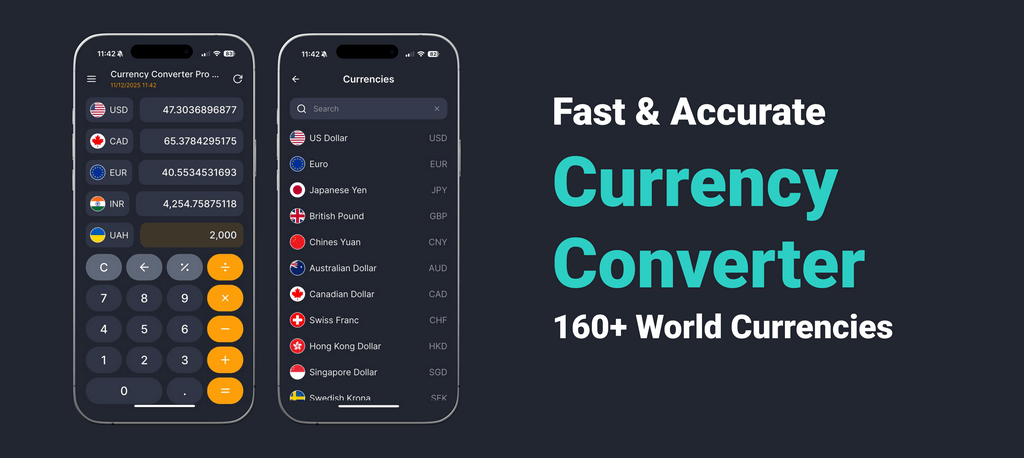


Currency Converter - Real-Time Exchange Rates for 160+ World Currencies
A currency converter is an essential tool that allows you to quickly and accurately convert between different world currencies. Whether you're planning an international trip, conducting business across borders, sending money to family abroad, or making investment decisions, understanding exchange rates and how currency conversion works is crucial for making informed financial choices.
Modern currency converters provide real-time exchange rates for over 160 world currencies, updated continuously throughout each trading day. These rates reflect the dynamic nature of global financial markets, where currency values fluctuate based on economic indicators, interest rates, political events, and market sentiment. The most accurate currency converters use data from interbank foreign exchange markets, central banks, and major financial institutions to provide mid-market rates—the average between buy and sell prices.
What is a Currency Converter?
A currency converter is a digital tool—available as websites, mobile apps, or desktop software—that calculates the equivalent value of one currency in terms of another currency. The calculation is based on current exchange rates, which represent the relative value between two currencies at a specific point in time.
Key Features of Modern Currency Converters:
- Real-time rates: Exchange rates updated throughout each trading day (24 hours, 5 days a week)
- Wide currency coverage: Support for 160+ world currencies including major currencies (USD, EUR, GBP, JPY, CNY) and emerging market currencies
- Historical data: Many converters provide historical exchange rate charts and trends
- Offline functionality: Some mobile apps allow basic conversions without internet connection (using cached rates)
- Multiple conversion modes: Support for converting single amounts, bulk conversions, or creating favorite currency lists
- Rate alerts: Notifications when exchange rates reach specific thresholds
The most reliable currency converters aggregate data from multiple sources including interbank markets, central banks (Federal Reserve, European Central Bank, Bank of England), and international financial institutions (IMF, World Bank) to ensure accuracy and reliability.
How Currency Converters Work
Currency converters operate on a simple mathematical principle: Amount × Exchange Rate = Converted Amount. However, the underlying process involves several sophisticated components:
Exchange Rate Sources
Modern currency converters pull exchange rates from multiple authoritative sources:
- Interbank Markets: The primary source where banks trade currencies with each other, providing the most accurate mid-market rates
- Central Banks: Official rates published by central banks (Federal Reserve, ECB, Bank of England, etc.)
- Financial Data Providers: Aggregated data from services like Reuters, Bloomberg, and major currency exchanges
- Real-time Market Data: Live rates from forex trading platforms during trading hours
Rate Calculation Methods
Mid-Market Rate:
This is the midpoint between the buy and sell prices in the interbank market. It's the "true" exchange rate before banks and exchange services add their margins. Mid-market rates are what currency converter apps typically display.
Buy/Sell Rates:
When you actually exchange currency through banks or exchange services, you'll receive rates that include margins (typically 2-5% for banks, 1-3% for specialized remittance services). These margins represent the service provider's profit and operational costs.
Update Frequency
High-quality currency converters update rates:
- During market hours: Multiple times per minute in active markets
- 24/5 schedule: Updated continuously during trading days (Monday-Friday)
- Weekend rates: Many converters show last Friday's closing rates during weekends
💡 For Real-Time Exchange Rates
Exchange rates change throughout each trading day. For the most up-to-date currency conversion rates updated in real-time, download our Currency Converter Pro Live app:
- Download on the App Store - Get live rates on iPhone and iPad
- Get it on Google Play - Get live rates on Android devices
The app provides real-time exchange rates for 160+ world currencies, updated throughout each trading day based on live market data.
Major Currency Pairs
The global foreign exchange market trades over 180 currencies, but approximately 85% of all trading volume involves just a handful of major currency pairs. Understanding these pairs helps you navigate currency conversion:
Most Traded Currency Pairs
- USD/EUR (US Dollar / Euro): The most liquid currency pair, representing the world's two largest economies. Average daily trading volume exceeds $580 billion.
- USD/GBP (US Dollar / British Pound): Known as "Cable" in trading circles, this pair reflects the relationship between the US and UK economies. Average daily volume: ~$360 billion.
- USD/JPY (US Dollar / Japanese Yen): A major carry trade pair, representing the world's third-largest economy. Average daily volume: ~$550 billion.
- USD/INR (US Dollar / Indian Rupee): One of the most actively traded emerging market pairs, driven by India's growing economy and significant trade volumes with the US. Average monthly search volume exceeds 20 million queries.
- USD/PHP (US Dollar / Philippine Peso): Highly active pair due to substantial remittance flows from the US to the Philippines (over $35 billion annually). Average monthly search volume exceeds 8 million queries.
- EUR/GBP (Euro / British Pound): Cross-currency pair reflecting European economic dynamics, especially post-Brexit.
- USD/CNY (US Dollar / Chinese Yuan): Growing importance as China's economy expands and the yuan becomes more internationalized.
Emerging Market Currency Pairs
Beyond major pairs, currency converters also support numerous emerging market currencies:
- Asian currencies: THB (Thai Baht), KRW (South Korean Won), IDR (Indonesian Rupiah), MYR (Malaysian Ringgit)
- Latin American currencies: MXN (Mexican Peso), BRL (Brazilian Real), ARS (Argentine Peso), COP (Colombian Peso)
- Middle Eastern currencies: AED (UAE Dirham), SAR (Saudi Riyal), ILS (Israeli Shekel)
- African currencies: ZAR (South African Rand), EGP (Egyptian Pound), NGN (Nigerian Naira)
- European currencies: PLN (Polish Zloty), TRY (Turkish Lira), SEK (Swedish Krona), NOK (Norwegian Krone)
A comprehensive currency converter should support all these currencies and more, providing users with the flexibility to convert between any currency pair they need.
Exchange Rate Basics
Understanding how exchange rates work is fundamental to using currency converters effectively:
What Determines Exchange Rates?
Exchange rates are influenced by multiple factors:
- Interest Rates: Central banks set interest rates that directly impact currency values. Higher interest rates typically strengthen a currency by attracting foreign investment.
- Inflation Rates: Countries with lower inflation rates generally see their currencies appreciate relative to currencies with higher inflation.
- Economic Growth: Strong GDP growth typically strengthens a currency, while economic weakness can lead to depreciation.
- Political Stability: Political events, elections, and policy changes can cause significant currency movements.
- Trade Balances: Countries with trade surpluses (exporting more than importing) often see currency appreciation.
- Market Sentiment: Investor confidence and risk appetite influence currency flows.
- Geopolitical Events: Wars, conflicts, and international tensions can cause safe-haven currencies (like USD) to strengthen while riskier currencies weaken.
Types of Exchange Rate Systems
Floating Exchange Rates (Most Common):
Currencies like USD, EUR, GBP, JPY float freely based on market supply and demand. Most major currencies operate this way.
Fixed Exchange Rates:
Some currencies are pegged to another currency (usually USD or EUR) at a fixed rate. Examples include some Gulf states' currencies and historically, the Chinese Yuan.
Managed Float:
Central banks occasionally intervene to influence exchange rates while allowing some market-driven movement.
Using Currency Converter Apps
Mobile currency converter apps offer several advantages over web-based converters:
Key Benefits of Mobile Apps
- Real-time Updates: Apps can update rates automatically in the background, ensuring you always have current data
- Offline Access: Many apps cache recent rates for offline use when internet is unavailable
- Rate Alerts: Set notifications for specific exchange rate thresholds
- History Tracking: View historical exchange rate charts and trends
- Favorite Lists: Save frequently used currency pairs for quick access
- Multiple Conversions: Easily convert between multiple currencies simultaneously
- Location-based Features: Automatically detect your location and suggest relevant currencies
Best Practices for Using Currency Converters
- Check rate update frequency: Ensure your converter updates rates regularly (preferably in real-time)
- Understand mid-market vs. actual rates: The rate shown is typically mid-market; actual rates you receive will include margins
- Compare multiple sources: Verify rates across different converters for accuracy
- Consider timing: Exchange rates fluctuate throughout the day; check rates at optimal times if making large conversions
- Account for fees: Remember that actual exchange rates include service provider margins and fees
- Use historical data: Review historical trends to understand currency volatility and patterns
Common Use Cases for Currency Converters
Travel and Tourism
Travelers use currency converters to:
- Budget for international trips by converting home currency to destination currency
- Understand local prices when shopping abroad
- Calculate tips and gratuities in foreign currencies
- Compare hotel and flight prices across different currencies
International Business
Businesses rely on currency converters for:
- Pricing products for international markets
- Calculating costs for importing/exporting goods
- Managing multi-currency accounting and financial reporting
- Evaluating international investments
Remittances and Money Transfers
Millions of people use currency converters when:
- Sending money to family abroad (especially remittances from US to countries like India, Philippines, Mexico)
- Choosing money transfer services by comparing exchange rates
- Understanding how much recipients will receive in local currency
- Planning remittance timing to maximize exchange rates
Online Shopping and E-commerce
E-commerce activities requiring currency conversion:
- Shopping on international websites
- Comparing prices across different country sites
- Understanding final costs including currency conversion fees
- Managing multi-currency shopping carts
Investment and Trading
Investors use currency converters for:
- Evaluating international investment opportunities
- Understanding currency exposure in portfolios
- Calculating returns on foreign investments
- Analyzing currency trends and making trading decisions
Education and Research
Students, researchers, and academics use converters for:
- Understanding international economic data
- Converting research figures for publications
- Comparing costs of education across countries
- Analyzing global economic trends
Frequently Asked Questions (FAQ)
Data Source and Trust
How we calculate exchange rates
Our exchange rate data is aggregated from multiple international sources including:
- Interbank foreign exchange markets (the primary source for mid-market rates)
- Central banks' official reference rates (Federal Reserve, European Central Bank, Bank of England, Bank of Japan, Reserve Bank of India, and others)
- International Monetary Fund (IMF) statistics and currency data
- Major financial institutions and currency data providers
- Real-time market data feeds from global exchanges
Rates are updated in real-time during market hours and reflect mid-market rates (the average between buy and sell prices). Actual rates you receive from banks or exchange services may include margins of 2-10% depending on the provider, transfer amount, and payment method.
Why mid-market rates matter
The mid-market rate represents the "true" exchange rate before service providers add their margins. Understanding this rate helps you:
- Compare different exchange services accurately
- Negotiate better rates for large transactions
- Make informed decisions about when to convert currencies
- Understand the true cost of currency conversion
For official exchange rates and monetary policy information, visit the International Monetary Fund or your country's central bank website (such as the US Federal Reserve for USD rates).
Last updated: January 2026