

CAD to USD — Convert Canadian Dollar to US Dollar
If you’re checking canada currency to us dollars, you’re usually doing something concrete: pricing a US subscription in CAD, paying a USD invoice, planning a cross‑border trip, or sanity‑checking what an exchange desk will hand you.
The converter above gives a live reference rate for Canadian Dollar (CAD, $) ↔ US Dollar (USD, $). Think of it as a benchmark that updates—not a guaranteed retail deal.
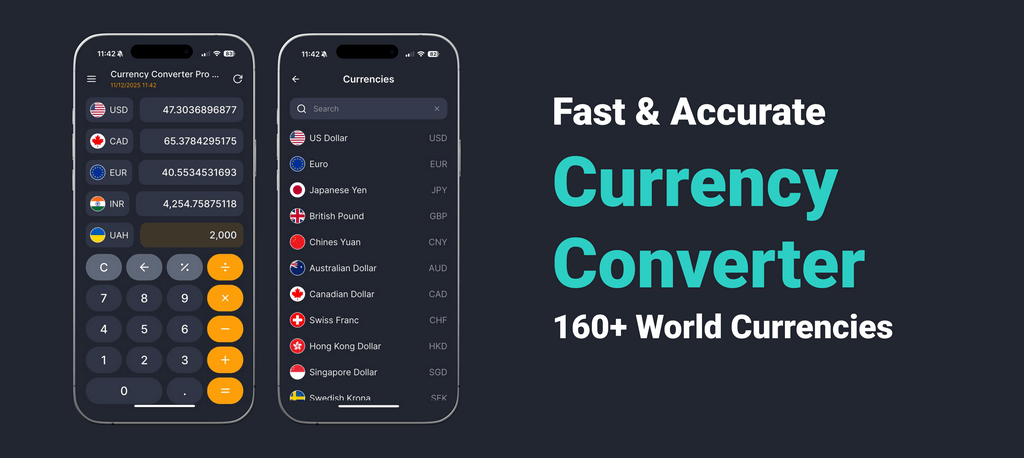
For the most up‑to‑date reference quote on the go, open Currency Converter Pro Live from the header. Then compare providers by the all‑in result once spreads and fees are included.
Live exchange rate: CAD → USD today
CAD/USD is commonly shown as US dollars per 1 Canadian dollar. So the quote answers: “How many $USD do I get for $CAD 1?”
Multiply or divide? A quick rule
If the quote is USD per 1 CAD, then:
- CAD → USD: multiply CAD × rate
- USD → CAD: divide USD ÷ rate
A simple sanity check: CAD→USD usually makes the number smaller (because 1 CAD is often less than 1 USD), while USD→CAD usually makes it larger.
How to convert CAD to USD (in practice)
Step 1: Enter the amount in CAD you plan to spend, withdraw, or send.
Step 2: Read the converter result in USD as your benchmark.
Step 3: Before you commit, price the same conversion through your real channel:
- Card purchase: issuer FX fee + network conversion rules
- ATM withdrawal: ATM operator fee + your bank fee + FX spread
- Bank transfer: transfer fee + spread (sometimes hidden)
The goal is not just “what’s the rate?” but “how many USD do I end up with for my CAD after costs?”
Common conversions (example math only — not live rates)
Example only (not a live rate): assume 1 CAD = 0.75 USD
| Amount | Example rate | Approx. result |
|---|---|---|
| 1 CAD | 0.75 USD per 1 CAD | 0.75 USD |
| 10 CAD | 0.75 USD per 1 CAD | 7.50 USD |
| 100 CAD | 0.75 USD per 1 CAD | 75.00 USD |
| 1,000 CAD | 0.75 USD per 1 CAD | 750.00 USD |
This table is a format guide for quick mental math. Your real result will vary with the current benchmark and the provider’s pricing.
Fees & spread: why your result differs by provider
- Spread: the markup between a benchmark and the retail rate you’re offered.
- Fees: transfer fees, cash‑exchange commissions, or card foreign transaction fees.
- Timing: weekends and off‑hours can lead to wider retail spreads.
CAD $ vs USD $: avoid the two-dollar-sign trap
Both currencies use the “$” symbol, so receipts and price tags can be ambiguous. When you see “$”, look for CAD or USD (or context like “US$”). This matters most for online pricing and cross‑border merchants that list totals in one currency but settle in another.
Card conversion vs bank conversion: what changes the outcome
With card payments, the exchange step often happens through the card network and your issuer. A card can show “no fee” but still include cost via an issuer FX fee or a less favorable retail rate. The clean comparison is always the final amount charged in CAD (or the USD you receive) after every fee.
Large transfers: compare “you pay” vs “they receive”
If you’re converting a meaningful amount (rent, tuition, invoices), ask the provider for an all‑in quote: total CAD you pay and total USD received. That removes guesswork around spread and fixed fees.
DCC prompt: “Pay in home currency or local currency?”
When you’re in the US, some terminals or ATMs may offer to charge you in CAD instead of USD. That’s usually Dynamic Currency Conversion (DCC).
Rule of thumb: choose USD (local currency) to avoid DCC markup, and let your bank/card network convert.
If you want a quick benchmark before you tap “Confirm,” check the current reference quote in the app via #app-download in the header.
Related pages
Need the reverse direction? Use the USD to CAD converter to convert USD → CAD.
For USD context (how quotes work, why “live” differs from retail), see the US dollar (USD) currency hub .
Compare USD against other popular pairs:
FAQ — CAD to USD
What is 1 CAD in USD today?
Use the converter for the live reference benchmark. Your bank, card, ATM, or exchange desk may apply a different retail rate due to spread and fees.
How do I convert CAD to USD (multiply or divide)?
If CAD/USD is quoted as USD per 1 CAD, multiply CAD × rate to get USD. To convert back (USD→CAD), divide USD ÷ rate.
Why is my rate different from what I see online?
Most online quotes are benchmarks. Retail providers add cost via spread, plus possible transfer fees, ATM fees, or card foreign transaction fees.
Do banks, cards, ATMs, and cash exchange use different rates?
Yes. Each channel prices FX differently. Compare the all‑in outcome: total CAD paid vs USD received (or vice versa).
Should I choose local currency or my home currency (DCC) at checkout/ATM?
In most cases, choose the local currency (USD in the US) to avoid DCC markup. DCC often replaces your network conversion with a merchant/ATM rate that’s worse.
Do weekend/holiday rates differ?
They can. Providers may widen spreads during weekends, holidays, or off‑hours. If timing matters, compare again during regular business hours.
I’m searching “200 CAD to USD” — what’s the fastest way to check?
Use the converter for a quick benchmark, then confirm your final outcome with your payment method. For the latest reference quote on mobile, open the app from the download section in the header.
Sources
- Bank of Canada — Official context for CAD and monetary policy signals.
- Federal Reserve — Official context for USD policy and financial conditions.
- BIS — FX market structure and benchmark vs retail pricing concepts.
- Visa — How card FX conversion works and why final amounts can differ.
- Mastercard — Currency conversion factors affecting charged amounts.
Educational only, not financial advice.
Last updated: January 21, 2026