

Card FX fees explained: why your “converted” total can differ from what you expected
Most people only notice currency conversion when something feels “off”: a checkout total that’s higher than the mental math, an ATM receipt that looks inflated, or a card statement where the final posted amount doesn’t match what you saw on the day. The tricky part is that several moving pieces can be involved—card-network pricing, your bank’s markup, fixed fees, and sometimes a “helpful” offer to charge you in USD.
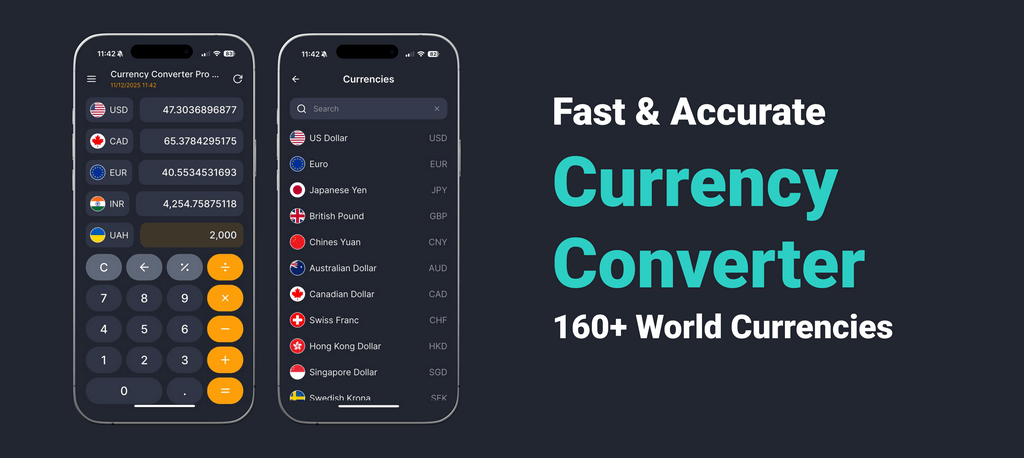
This guide walks through the full chain without jargon. Use the on-page converter at the top for a fast reference check. And when you want the same check while traveling or shopping, keep the currency app within reach—because the moments where this matters (a terminal prompt, a hotel desk, a checkout timer) are exactly the moments when you don’t want to open five tabs and do arithmetic in your head.
1) The two rates people mix up: network pricing vs your bank’s retail outcome
When you pay in a foreign currency, the conversion is typically priced by the card network (Visa/Mastercard) and then finalized by your card issuer (your bank). That means two layers of pricing can be involved:
- Network pricing (processing layer): the conversion context used behind the scenes for settlement.
- Issuer retail outcome (what you pay): the posted amount after bank markup, fees, and timing effects.
Why this matters: online converters are best treated as a reference for planning and for catching direction mistakes. Your statement is the retail reality after provider pricing and fees. The goal is not to “match the converter perfectly,” but to understand what can legitimately change—and what is a red flag worth disputing.
Sanity check that saves real money: verify the direction
Before you troubleshoot fees, confirm you’re reading the quote in the right direction. “USD → JPY” is usually shown as “JPY per 1 USD,” so results look big. If you accidentally invert the quote, you can misread the outcome by a lot. If you’re converting a trip budget quickly, the app helps you double-check direction on the spot.
How to spot a direction error in 5 seconds
- If the foreign currency uses many units (JPY, IDR), USD → local usually looks like a big number.
- If you expected “about one-to-one” and got a number with extra zeros, you might be looking at the correct direction but unfamiliar denomination.
- If you got a tiny number (e.g., “0.00…”) when converting USD to a typical local currency, you may have inverted it.
2) The three places the cost hides
Conversion costs rarely appear as one clean line item. They tend to show up in three places—sometimes all at once.
A) Rate margin baked into the conversion
Some providers “widen” the rate (give you a slightly worse price) instead of charging a visible fee. That’s why two services can advertise “no fees” and still land at different totals. If you’re comparing options, compare final delivered totals on the same test amount—not marketing language.
B) Fixed fees that punish small transactions
ATMs and some providers charge flat fees. Flat fees hurt small amounts the most. If you withdraw small chunks repeatedly, you often pay more than if you plan one larger withdrawal and manage cash carefully. This is one reason “I’ll just take out $20” can be the most expensive move on the trip.
C) Percentage fees and surcharges
Foreign transaction fees, card processing surcharges, and platform conversion fees are often percentage-based. They scale with transaction size and can silently stack with other costs. A card can have “no annual fee” but still be a bad travel card if it adds a consistent FX surcharge.
3) Why the posted amount can drift: timing, authorization, and settlement
Here’s a common “wait, what?” moment: you check a conversion on Monday, the merchant authorizes the card on Monday, but the final posted transaction settles later. The amount can drift because the conversion is applied at the time and method specified by the network/issuer—not necessarily at the moment you saw the terminal screen.
Module: authorization holds vs final settlement
Hotels, car rentals, and some online merchants place an authorization hold first (a temporary reservation of funds). The final settlement may post later for a different amount. Tips, partial refunds, and late adjustments can also change the posted total. This is not always a “bad rate”—it’s often timing mechanics.
Module: deposits and the “hotel shock” effect
Travel merchants may authorize extra as a deposit. If you’re converting mentally, that hold can look like a sudden spike. Best practice: plan for deposits, keep receipts, and use one consistent reference check (the on-page converter or the app) so you compare like with like.
Module: refunds and reversals rarely “undo” the same way
Refunds can settle at a different time than the original charge. Even if the local-currency amount is identical, FX timing can make the USD refund slightly different. If you’re tracking expenses tightly, expect small differences and focus on whether the merchant refunded the correct local amount.
4) The DCC question: “Do you want to pay in USD?”
Dynamic Currency Conversion (DCC) is the pop-up that offers to charge you in your home currency at the terminal or ATM. It’s framed as convenience (“Know the USD amount now”). The catch: it can route your payment through a conversion path chosen by the merchant/terminal operator, which may include an extra margin that’s hard to evaluate on the spot.
The simple rule that works in most countries
If you have a choice, choose the local currency of the transaction. Let your card network and issuer handle conversion. Choosing the “converted-to-USD” option can add operator-set margin on top of whatever your bank does.
Where DCC shows up most
- Hotels and car rentals (bigger totals, more “helpful” screens).
- Tourist-area terminals and duty-free shops.
- ATMs that offer “guaranteed exchange rate” pages.
- Online checkouts that quietly switch the billing currency when they detect a US card.
How to handle DCC in real life (without a debate at the counter)
- Look for the wording: “Charge in USD” / “Guaranteed USD amount” / “Convert now.”
- Choose local currency, then take a photo of the receipt if you’re worried about disputes.
- If the screen is confusing, do a 10-second reference check in the on-page converter—or use the app when you’re not at a desk.
5) A fast method to estimate your “real” outcome before you tap
- Get a reference conversion: use the converter above or the app.
- Add your known bank rules: if your card charges a foreign transaction fee, account for it.
- Watch for DCC prompts: choose local currency unless you have a strong reason not to.
- For ATMs: avoid repeated small withdrawals that multiply fixed fees.
- For subscriptions: expect different totals month to month if the service bills in a foreign currency.
Mini checklist for international online shopping
Some websites offer “Pay in USD” at checkout. It can be the same idea as DCC, just online. If both options are available, compare once with a reference check and pick the option that keeps fees transparent. For quick anchors, you can cross-check common pairs like EUR to USD or USD to MXN to keep your mental math honest.
6) How to read your statement like a detective
If you want to know whether you paid “a fair conversion,” don’t stop at the posted total. Read the line items and context. Different issuers format statements differently, but the logic is consistent.
Step-by-step statement review
- Original currency amount: verify the merchant charged what you agreed to in local currency.
- Exchange rate note (if shown): some banks show a conversion rate or “exchange rate used.” Treat this as context, not a promise of matching a website screenshot.
- Foreign transaction fee line: some issuers show it as a separate fee, others bundle it into the conversion.
- Merchant name + location: useful for spotting DCC or “cross-border” processing where the acquirer is in a different country than the store.
Red flags worth a second look
- The receipt shows one currency, but your statement shows another (possible DCC or currency switching).
- The local amount is wrong (merchant error; easier to dispute than exchange-rate differences).
- A conversion fee appears twice (rare, but worth checking if multiple intermediaries were used).
7) Card vs cash vs ATM: the practical decision framework
There isn’t one universal “best” method. The best approach depends on fixed fees, your card’s foreign fee policy, and how often you’ll make small purchases. Use this framework:
When cards usually win
- Mid-to-large purchases where a fixed ATM fee would be proportionally huge.
- Situations where you want dispute protection (hotels, rentals, online purchases).
- Countries where cash exchange is inconvenient or risky.
When cash can still make sense
- Small local merchants that add card surcharges.
- Places where card acceptance is spotty.
- Budget control: some travelers spend better with cash envelopes.
ATM strategy that reduces friction
- Prefer fewer, larger withdrawals instead of many small ones (reduces fixed-fee “tax”).
- Decline “guaranteed rate” screens when offered; choose local currency withdrawal.
- Keep a reference check tool ready (the on-page converter or the app) to sanity-check totals.
9) Special cases that confuse people (and what to do)
Tips and split bills
Restaurants may authorize a base amount and then settle later with a tip. If you’re splitting a bill, the merchant can run multiple settlements. Expect the posted totals to differ from what you saw at the table, especially if the tip was added after the first authorization.
Prepaid reservations and “pay at property” wording
Some travel sites show a USD estimate but bill the property in local currency, while others process the payment through an international merchant account. If you want predictable outcomes, look for the billing currency in the fine print and do one reference check using the on-page converter before you confirm.
Subscriptions billed in foreign currency
Streaming services, SaaS tools, and marketplaces may bill you in a foreign currency each month. Even if the local price doesn’t change, your USD total can vary with FX. If you’re budgeting, track the foreign-currency price as the “stable” number and treat the USD total as variable. A quick check in the app is often enough to prevent surprises.
10) Multi-currency cards, wallets, and “pay in the merchant’s currency”
Multi-currency cards and wallets are popular because they let you hold balances in multiple currencies. They can be great—but they also add a new decision: whether to convert now (when you top up) or later (when you spend).
When converting ahead of time helps
- If you have a large upcoming expense in one currency and want predictability.
- If your wallet offers a transparent, low-cost conversion with clear fees.
- If you’re building a travel budget and want to “lock in” a working estimate.
When converting on the spot is simpler
- If you don’t know which currencies you’ll need (multi-country trips).
- If you prefer fewer moving parts and want one provider to handle conversion.
- If you want the cleanest comparison: local price first, then conversion.
Either approach can work. The key is consistency: use the same reference check method across options so you don’t mix apples and oranges. For example, if you’re jumping between regions, it helps to keep a few “anchor” pages bookmarked, like USD to INR or USD to JPY .
11) A simple provider-comparison worksheet (2 minutes)
If you want to choose between two cards, two wallets, or “card vs cash,” don’t overthink it. Run a small, consistent comparison.
- Pick one test amount: many people use $50 or $100 because it’s meaningful but not huge.
- Pick one currency you actually spend in: for many travelers that’s EUR, GBP, MXN, JPY, or INR.
- Do one reference check: use the converter at the top (or the app when mobile).
- Add fees you know: foreign transaction fee percentage, fixed ATM fees, or wallet conversion fees.
- Decide the “winner” by final cost and convenience: sometimes a slightly higher cost is worth fewer steps.
This keeps you focused on what matters: the final outcome and your real behavior. A “perfect” method that you won’t use at the terminal is worse than a quick method you actually follow.
One last habit: whenever a screen offers “guaranteed” conversion, pause and treat it as a pricing choice, not a helpful feature. A quick reference check is usually enough to keep control.
8) Common conversions (example math only — not live rates)
Example only (not a live rate): assume 1 USD = 100 “units” (placeholder example) just to show the math. Real results vary by provider, spread, and fees.
| Amount | Example rate | Approx. result |
|---|---|---|
| $10 | 100 units per 1 USD | 1,000 units |
| $50 | 100 units per 1 USD | 5,000 units |
| $100 | 100 units per 1 USD | 10,000 units |
| $1,000 | 100 units per 1 USD | 100,000 units |
The point of the table is not the number—it’s the habit: pick one test amount (like $50) and use it to compare providers consistently.
Related pages
- US dollar (USD) currency hub
- EUR to USD converter
- USD to JPY converter
- GBP to USD converter
- USD to MXN converter
- USD to INR converter
Sources
- Visa: exchange rate calculator — how network rates are presented and checked.
- Mastercard: currency conversion help — conversion context and tools from the network side.
- CFPB: foreign transaction fees — what the fee is and why it appears.
- ECB: reference exchange rates (background) — public reference-rate context.
FAQ
Why does my bank conversion differ from what I see online?
Online converters usually show a reference context for planning. Your bank may apply a markup, foreign transaction fees, and the conversion at settlement. The posted amount is the final result after those layers.
Is “pay in USD” at a terminal ever a good idea?
It’s usually more expensive because it introduces a merchant/terminal-set conversion. When in doubt, choose the local currency and let the network/issuer convert.
What’s the simplest way to compare two cards?
Use the same test amount and compare final posted totals. If one adds a visible fee and the other widens the rate, the only fair comparison is the end result.
Why do small ATM withdrawals feel so costly?
Fixed fees dominate small amounts. Withdrawing $20 three times can cost more than withdrawing $60 once. Reduce the number of withdrawals when possible.
Why did my hotel charge look different later?
Hotels often place an authorization hold and settle later, sometimes after adjustments. Timing can change the converted total even if the local-currency charge is correct.
Can refunds look different from the original charge?
Yes. Refunds settle later and can use a different conversion context. Focus on whether the merchant refunded the correct local amount.
How do I avoid direction mistakes when converting?
Confirm the direction (USD→foreign vs foreign→USD). If the result magnitude looks wrong, you may be looking at the inverse quote. Use the on-page converter (or the app) to verify quickly.
Educational only, not financial advice.
Last updated: January 21, 2026