

PKR to USD — Convert Pakistani Rupee to US Dollar
You don’t usually convert pakistani rupees to us dollar for fun—you do it to answer a decision. “How much is this invoice in dollars?” “What will the transfer land as?” “Is this rate from my bank actually fair?” For Pakistani Rupee (PKR, ₨) → US Dollar (USD, $), the big challenge is that you can see multiple plausible numbers depending on where you look.
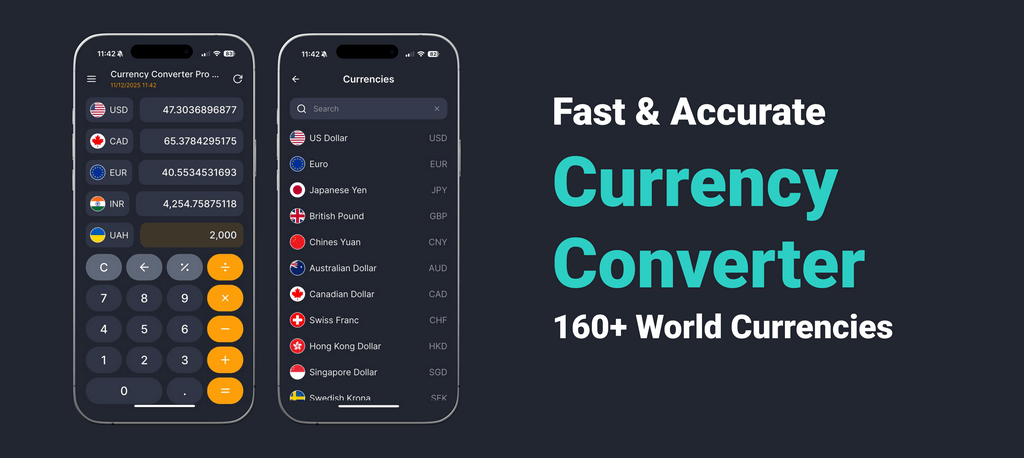
This page gives you a clean baseline: the converter shows a live reference quote for PKR→USD, and the demo converter in the site header lets you run the same check instantly. When you need repeated re-checks (sending money, comparing services), getting the app is usually faster than reopening pages.
Live exchange rate: PKR → USD today
“Live” here means the converter updates an indicative rate you can use for orientation. PKR→USD is often quoted as USD per 1 PKR (a small decimal), so the quick rule is:
- PKR × (USD per PKR) ≈ USD
Sometimes you’ll also see the inverse quote (PKR per 1 USD). In that case: - USD × (PKR per USD) ≈ PKR
Tiny decimals are normal: why PKR→USD looks “weird”
Because 1 PKR is much less than 1 USD, the USD-per-PKR quote will look like a small decimal. That’s normal. If you prefer easier mental math, you can convert using a larger anchor amount (for example 1,000 PKR) and scale.
“Per 1 USD” vs “per 1 PKR”: the direction-flip trap
When providers display “PKR per 1 USD,” it’s easy to accidentally treat it as “USD per 1 PKR.” Quick fix: - Look for the phrase “per 1 USD” or “per 1 PKR”. - Run a tiny test amount in the header converter and confirm the output feels plausible.
How to convert PKR to USD (in practice)
Step 1 — Check the converter (or the header demo converter) for a baseline at the time you plan to convert.
Step 2 — Identify your real channel:
- Money transfer / remittance: service fee + rate margin
- Bank conversion: can include wider spreads or fixed charges
- Card purchase: rare for PKR→USD directly, but possible in online billing scenarios
- Cash exchange: desk spreads and tiering by amount
Step 3 — Compare options using one fixed test amount (e.g., ₨50,000) and focus on:
“How many dollars do I end up with after all fees?”
Corridor pricing: why “good rate” doesn’t guarantee best outcome
Transfer services can compete on either: - a better-looking rate with higher fees, or - slightly worse rate with lower fees.
So don’t compare rates alone. Compare delivered USD after fees for the same PKR amount.
Common conversions (example math only — not live rates)
Example only (not a live rate): assume 1 PKR = 0.0035 USD (example).
| Amount (PKR) | Example rate | Approx. result (USD) |
|---|---|---|
| ₨1,000 | 0.0035 USD per 1 PKR | $3.50 |
| ₨5,000 | 0.0035 USD per 1 PKR | $17.50 |
| ₨10,000 | 0.0035 USD per 1 PKR | $35.00 |
| ₨25,000 | 0.0035 USD per 1 PKR | $87.50 |
| ₨50,000 | 0.0035 USD per 1 PKR | $175.00 |
| ₨100,000 | 0.0035 USD per 1 PKR | $350.00 |
A “rounding reality” note
When values are small decimals, rounding can move the displayed result by a few cents—especially if a provider rounds at each step or shows fewer decimals. That’s another reason to compare final delivered USD rather than obsessing over the displayed quote.
Fees & spread: why your result differs by provider
Your baseline quote is a starting point. Providers can change the outcome through:
- Rate margin (spread): baked into the quote you’re offered
- Transfer fees: fixed fee, percentage fee, or both
- Bank charges: service fees or intermediary fees
- Timing buffers: some services widen pricing outside active market hours
Cross-rate routing: why PKR→USD can vary more than you expect
Some retail systems infer PKR rates using broader pricing engines and apply their own margins. Two services can be “consistently different” without either being broken. The practical solution is simple: compare the delivered USD for your test amount.
DCC prompt: “Pay in home currency or local currency?”
DCC mainly shows up on card terminals/ATMs during travel. For PKR→USD it’s less common, but if you ever see “Pay in PKR vs pay in USD”: - choosing the local currency of the transaction usually avoids operator-set markups. - choosing the “converted” option often includes extra margin.
Related pages
- If you need the reverse direction, use the USD to PKR converter.
- For USD basics and reference context, see the US dollar (USD) currency hub .
- For cross-checking pricing models across popular USD baselines, compare USD to INR , USD to COP , USD to GBP , or USD to ILS .
FAQ — PKR to USD
What is the PKR to USD rate today?
Use the converter on this page (or the header demo converter) for a live reference quote. Treat it as a baseline—banks and transfer services can deliver a different amount after fees and rate margins.
Do I multiply or divide to convert PKR to USD?
If the quote is USD per 1 PKR, you multiply: PKR × (USD per PKR) ≈ USD. If you’re given PKR per 1 USD, you multiply in the other direction: USD × (PKR per USD) ≈ PKR.
Why does my transfer service show a different PKR→USD result than the converter?
Providers apply spreads and fees. Some show the fee separately; others embed their margin in the offered rate. Compare the delivered USD after all charges for the same PKR amount.
Are small PKR→USD conversions inefficient?
Often yes—fixed fees and minimums can dominate small amounts. If you send money regularly, test a few typical amounts and compare delivered USD after fees.
Why do PKR→USD quotes show tiny decimals?
Because 1 PKR is worth much less than 1 USD. Using a larger anchor amount (like 1,000 PKR) makes the math easier to interpret.
What’s the best way to compare two services?
Pick one PKR test amount and compare the final delivered USD after all fees. Repeat once with a larger amount to see whether fees or spread dominate.
Sources
- State Bank of Pakistan: official site — authoritative context for PKR and monetary/FX information.
- Federal Reserve: central banking context — USD monetary context and reference materials.
- BIS: FX market statistics — background on FX markets and retail vs reference pricing.
- IMF: exchange rate topics — explainer-level background on exchange rates.
Educational only, not financial advice.
Last updated: January 21, 2026