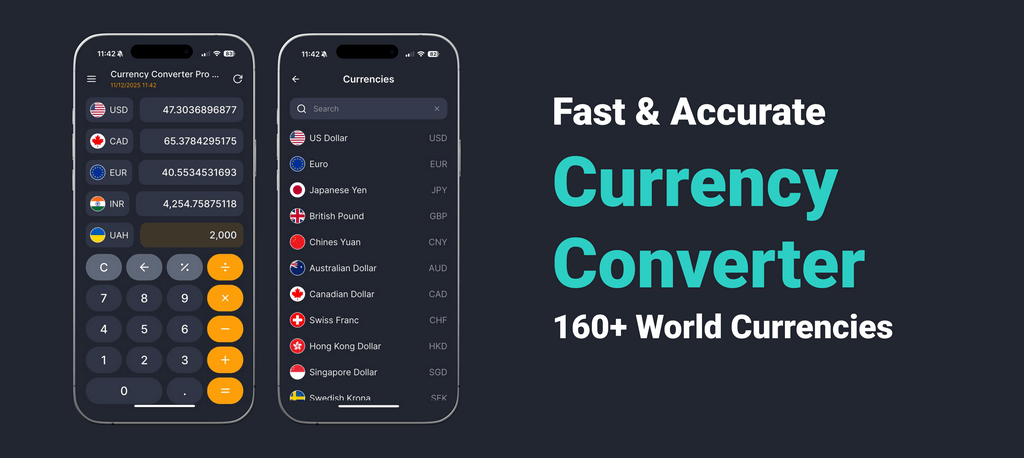


PLN to USD Converter
If you need to convert Polish zloty to US dollars (PLN to USD), it’s usually because something in real life is priced in USD: a freelance payout, an online purchase, a subscription, sending money abroad, or travel expenses. This page helps you estimate the currency PLN to USD rate and understand why your final result can differ between banks, cards, ATMs, and transfer services.
Need a live PLN → USD conversion (not just an estimate)?
Check real-time rates and conversion history in Currency Converter Pro Live: Download on the App Store • Get it on Google Play
For everyday planning, many people use a rough band (for example, “PLN in dollars” estimates). But for a proper benchmark and for larger amounts, it’s best to use official reference rates and then compare them with what your provider actually applies at checkout or transfer confirmation.
Official exchange-rate sources for PLN ↔ USD
These sources are commonly used as “ground truth” benchmarks:
- NBP Table A (average rates) — official benchmark for foreign currencies quoted in PLN (includes USD): NBP Table A
- NBP archive (Table A history) — check previous business days and published tables: NBP Table A archive
- NBP Web API — official JSON/XML rates endpoint (useful for automation and validation): api.nbp.pl
- Federal Reserve (H.10) — U.S. official source for selected exchange rates (USD-focused reference): Federal Reserve H.10
How to read official rates for PLN → USD
NBP commonly publishes USD as “1 USD = X PLN”. If you need PLN to USD, you can convert using the inverse:
USD = PLN ÷ (PLN per 1 USD)
This is why different websites can show the rate in different directions. Your bank/app might display PLN→USD directly, while official tables often show USD→PLN.
If you need the opposite direction, use USD to PLN. For nearby popular pairs and tools, you can also link users to PLN to EUR, EUR to PLN, and PLN Converter.
Quick conversion table (PLN → USD)
Use this table for quick budgeting. For an exact number at this moment, use a live converter (and compare it with your bank’s “final amount” before you confirm).
- 10 PLN ≈ (live PLN→USD)
- 20 PLN ≈ (live PLN→USD)
- 50 PLN ≈ (live PLN→USD)
- 100 PLN ≈ (live PLN→USD)
- 200 PLN ≈ (live PLN→USD)
- 500 PLN ≈ (live PLN→USD)
- 1000 PLN ≈ (live PLN→USD)
Tip: if you’re validating a number, compare your result to an official benchmark (NBP/Fed) and then account for provider costs. The gap is usually explained by fees and spreads rather than “mystery movements”.
100 PLN to USD
100 PLN to USD is one of the most common checks because it’s a comfortable “test amount” for online purchases and everyday spending. The best way to get an accurate result is to use a live PLN to USD converter and compare that with your provider’s final quote.
If your result looks worse than expected, common reasons are: a bank’s exchange margin (spread), card network rules, transfer fees, or a “convenience conversion” at checkout.
1000 PLN to USD
1000 PLN to USD matters more because small differences add up. If you convert larger amounts for travel, regular transfers, or international expenses, compare providers by the net USD you receive (or the net USD you’re charged), not just the headline rate.
PLN in dollars: the simplest way to estimate
For a fast mental estimate, people often use a rounded “rule of thumb”. For anything important (big transfers, budgeting, invoices), use an official benchmark and then confirm a live provider quote right before you exchange.
Bank and payment system fees (what really changes your result)
When you exchange PLN to USD, costs usually come from:
- Spread (rate markup): the provider converts at a slightly worse rate than the benchmark.
- Fixed fees: common on transfers; hits small amounts hardest.
- Percentage fees: more noticeable on larger conversions.
- ATM/card extras: ATM operator fees, bank withdrawal fees, or special FX rules for cash withdrawals.
- Dynamic Currency Conversion (DCC): a “we’ll convert for you” offer at an ATM/terminal/checkout that often uses a worse rate.
How to pay less in practice
- Compare the final charged/received amount at confirmation, not only the displayed rate.
- Watch fixed fees for small transfers and percentage fees for large conversions.
- Be careful with DCC: compare totals before accepting “convenient conversion”.
- If you convert often, prefer providers that show full costs clearly before you confirm.
Frequently Asked Questions (FAQ)
Last updated: January 21, 2026